Clavicle plate profile
The clavicle shaft plate is laser marked for orientation. It has locking holes, a tubularised under surface, and standard and extended compression or reduction slots. The plate-to-screw interface is low profile, the anterior surface is rounded and the medial and lateral edges are bevelled. These shapes are aimed at minimising irritation.
Humeral plate hole logic
The humeral plates share uniform hole spacing and threaded holes for the locking-screw option. They offer compression, neutral and buttress screw positions. Their ends are bullet shaped for submuscular insertion. An aiming guide mounts on the proximal humeral plate to direct K-wires and the drill toward each proximal locking hole.
Distal humerus from three sides
The distal medial, distal lateral and distal posterolateral plates are offered left and right. The posterolateral plate comes with or without a support. An extra-articular plate follows the distal shaft. Variable-angle holes are marked on the medial, lateral and posterolateral plates. Indications are intra-articular and comminuted supracondylar fractures, osteotomies and nonunions.
Olecranon and proximal radius
The anatomical olecranon plate has a curved head with variable-angle holes, so several screws can be aimed into the olecranon fragment. It is indicated for fractures, osteotomies and nonunions, particularly in osteopenic bone.
Distal radius volar plate
The volar distal radius plate uses variable-angle locking technology. Its holes allow up to 15° of off-axis screw angulation in all directions. Rounded edges, a polished surface and countersunk screws are designed to reduce the risk of soft-tissue irritation. K-wire holes allow preliminary fixation. A narrow volar plate is offered for smaller anatomy, and a guiding block directs drilling and screw insertion at the nominal angle. Narrow, rim, dorsal and straight plates complete the radius range.


 PIONEERLower extremity plates
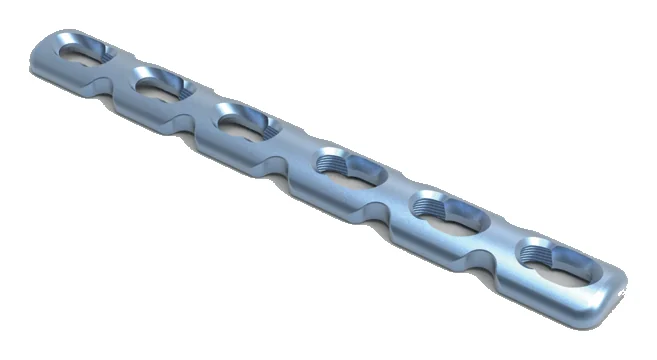 PIONEERPelvic and reconstruction plates
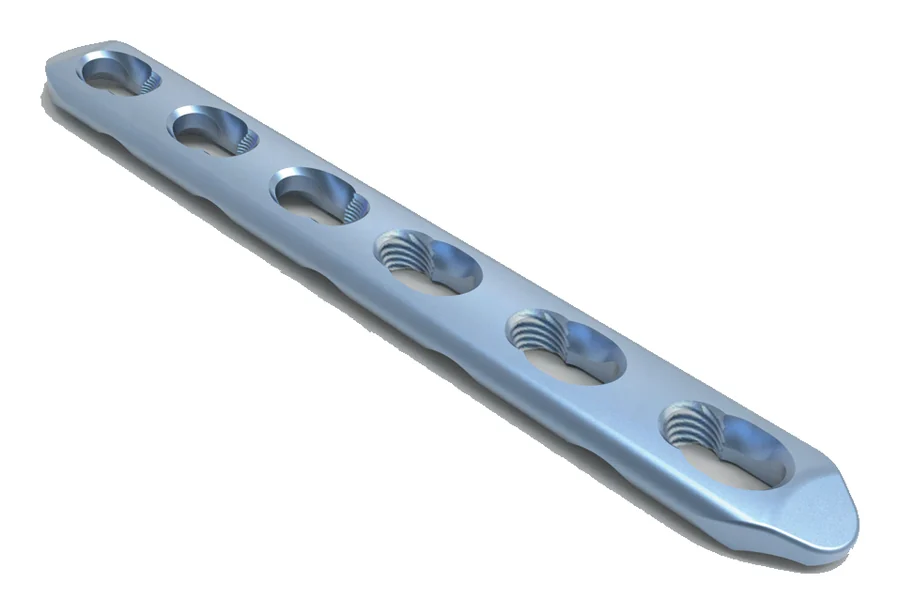 PIONEERStraight and general plates
 REGULATitanium anchors
 REGULAHeadless titanium anchors
 REGULAPEEK anchors
 REGULAKnotless anchors